
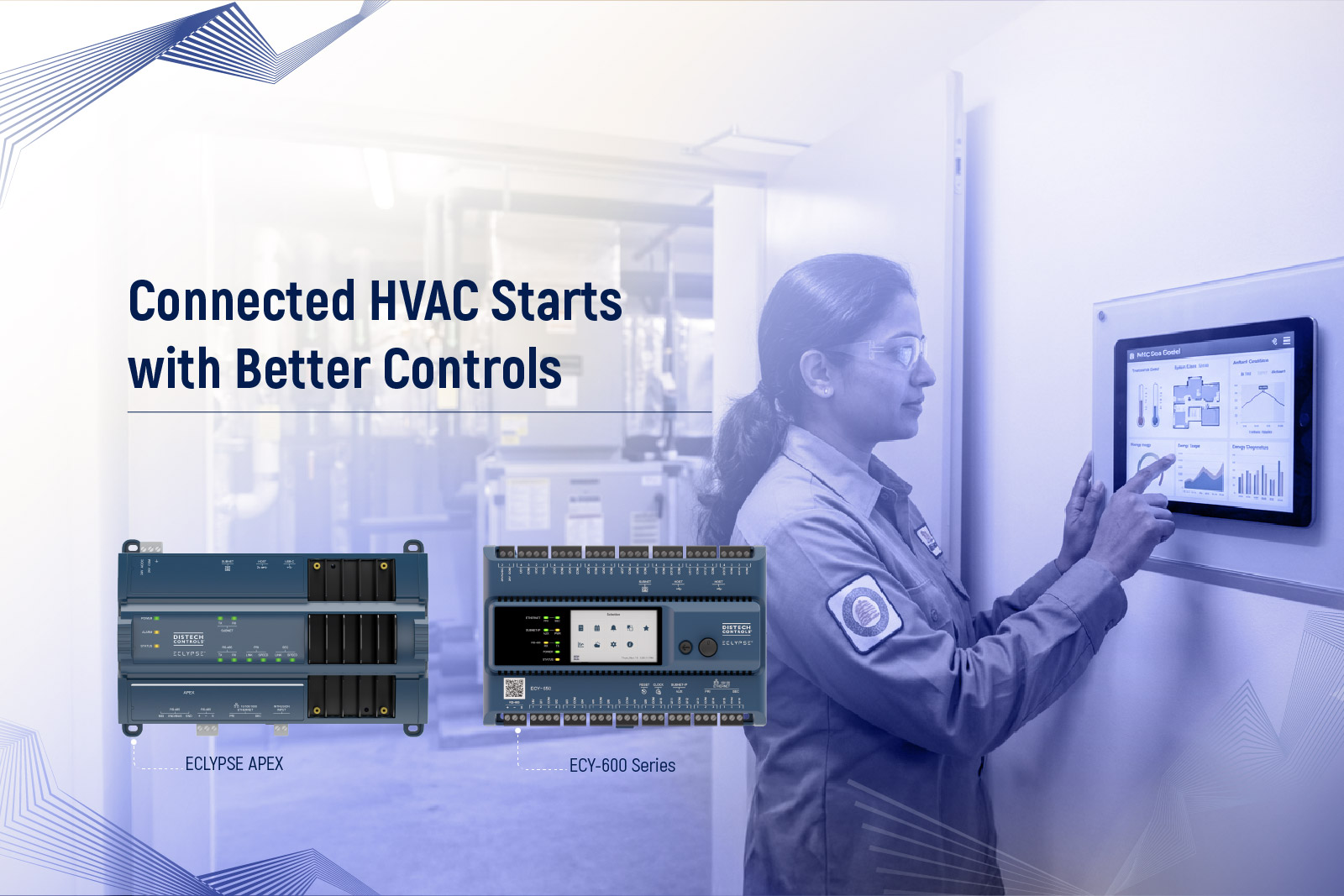
HVAC equipment is no longer evaluated only by its mechanical performance. Increasingly, consultants, system integrators and building owners also expect equipment to communicate, integrate, and operate as part of a wider Building Management System (BMS).
For HVAC OEMs, AHU manufacturers and chiller manufacturers, this changes the role of controls. A controller is no longer simply an internal component that starts fans, positions valves or manages a compressor sequence. It is also the digital interface between the equipment and the building automation system.
As commercial buildings become more connected, BACnet-ready controls can help manufacturers deliver equipment that is easier to integrate, commission, monitor and scale across different projects.
This is where open building automation becomes important. By combining application-specific control logic with open communication, manufacturers can deliver smarter equipment without forcing the end customer into a closed controls ecosystem.
Why Controls Are Becoming Part of the HVAC Product
Traditionally, an HVAC OEM could focus primarily on mechanical design and leave BMS integration into the project system integrator. That approach is becoming less practical as specifications increasingly define communication requirements alongside mechanical performance.
An AHU may need to expose supply-air temperature, fan status, filter alarms, valve position and operating mode to the central BMS. A packaged HVAC unit may need to communicate alarms and operating data. A chiller or plant controller may need to exchange equipment status, setpoints and performance information with a supervisory platform.
When these requirements are considered only after the equipment reaches the site, integration can become unnecessarily complex. Additional gateways, custom programming, point mapping, and repeated coordination may be required.
For manufacturers, integrating the control strategy earlier can turn controls into part of the product architecture rather than a project-site workaround.
What Does BACnet Ready HVAC Equipment Mean?
BACnet-ready HVAC equipment is designed to communicate relevant operating information with a compatible building automation system using the BACnet protocol.
BACnet is an open communication protocol developed for building automation and control. It provides a standardized framework through which compatible controllers and building systems can exchange information.
For an HVAC manufacturer, this means the equipment controller can be designed not only to execute local control logic but also to expose defined information to the wider BMS.
Depending on the application, this may include operating status, temperatures, setpoints, alarms, fan status, valve or damper positions, equipment modes, and other required parameters.
The important point is that BACnet compatibility does not replace good control engineering. The manufacturer must still define the correct sequence, points, alarms, and operating logic. BACnet provides the communication layer that helps make this information accessible to the rest of the building’s automation architecture
Why Open Building Automation Matters to HVAC Manufacturers
Commercial HVAC equipment is installed in buildings using many different BMS platforms. A manufacturer that depends entirely on a proprietary communication environment can therefore create additional integration of work for consultants, contractors and system integrators.
An open protocol approach provides greater flexibility. When equipment uses appropriately engineered BACnet-ready controls, it can be integrated into compatible BMS architectures without requiring the end customer to adopt the same controls ecosystem for the entire building.
For manufacturers, this can support broader project compatibility, simplify coordination with BMS contractors, and make the equipment easier to specify in projects where open communication is required.
For building owners, it supports long-term flexibility. Equipment can remain part of the building automation system even as supervisory platforms, monitoring requirements or other building systems evolve.
Open communication is therefore not simply a technical feature. It can become part of the equipment manufacturer’s value proposition.
Smart Controls for HVAC OEMs
HVAC OEMs often manufacture packaged or semi-packaged equipment that must perform reliably as a standalone system while also integrating with a wider BMS.
This creates several control challenges. The controller must execute the OEM’s application logic, communicate with field devices, provide alarms and diagnostics, and make the required information available to the building automation network.
Meeting the Demand for BMS-Compatible Equipment
Consultants and customers increasingly expect connected HVAC equipment. Providing native BACnet communication at the controller level can help OEMs deliver equipment that is ready for integration instead of relying on additional communication layers at site.
Reducing Engineering and Commissioning Complexity
A standardized controller strategy can help an OEM repeat proven sequences across product families. Defined BACnet points, alarm structures and control logic can also reduce repeated project-by-project engineering.
When the equipment arrives with the intended control functionality already engineered, site teams can focus on integration and functional verification rather than rebuilding the equipment control philosophy.
Supporting Smarter HVAC Operation
Modern HVAC control can incorporate temperature, pressure, airflow, fan, valve, damper, and other application parameters depending on the equipment design. The controller can use these inputs to execute local sequences while simultaneously making selected information available to the BMS.
Distech Controls ECLYPSE® Connected Controllers can be applied to HVAC control applications where programmable logic, connectivity and open building automation integration are required. The exact controller should be selected according to the equipment architecture, I/O count, communication requirements, and application complexity.
Building Automation for AHU Manufacturers
Air Handling Units are a strong example of why mechanical equipment and controls should be engineered together.
An AHU may include supply and return fans, VFDs, cooling and heating coils, control valves, dampers, filters, temperature sensors, humidity sensors, pressure sensors and safety interlocks. The controller must coordinate these components as one functional system.
Advanced AHU Sequences
Depending on the AHU design, the control sequence may include fan start/stop logic, VFD speed control, temperature regulation, humidity control, valve modulation, damper positioning, filter monitoring, pressure control, and alarm handling.
Embedding these sequences within the equipment control package gives the AHU manufacturer greater control over how the unit is intended to operate.
Connecting AHUs to Different BMS Platforms
AHUs may be installed on projects using different building automation platforms. Native BACnet/IP communication at the controller level can simplify the exchange of relevant AHU data with a compatible central BMS.
Instead of treating BMS connectivity as a separate site activity, the manufacturer can define the points and information that should be exposed as part of the AHU control design
Accurate Environmental Control
Temperature and humidity measurements are central to many AHU applications. Depending on the design, additional measurements such as duct pressure, differential pressure, or air-quality parameters may also be incorporated.
ECLYPSE® Connected Controllers can provide the programmable control layer for AHU and ventilation applications while supporting integration into an open building automation architecture.
Automation for Chiller Manufacturers and Central Plant Equipment
Chillers and associated plant equipment operate at the heart of many commercial HVAC systems. Their control requirements extend beyond individual equipment operation because chillers often need to coordinate with pumps, cooling towers and the wider building load.
From Equipment Control to Plant Coordination
At plant level, control strategies may include chiller staging, pump sequencing, cooling-tower operation, equipment enable/disable logic, lead/lag rotation, setpoint management and alarm monitoring.
The exact sequence depends on the mechanical design, but effective automation should coordinate the equipment as a system rather than as isolated components.
Making Chiller Information Available to the BMS
A central BMS may need access to operating status, temperatures, alarms, setpoints, and other defined plant information. BACnet-ready control architecture can provide a standardized method of exchanging this information with compatible building automation platforms.
Monitoring Plant Performance
Supervisory software can provide operators with graphical visualization, alarms, and historical trends for plant operation. This helps facility teams understand how equipment is operating over time rather than relying only on instantaneous values.
Distech Controls ECY plant controllers can be applied to central plant and mechanical control applications, while EC-Net can provide the supervisory layer for centralized visualization and monitoring. Controller and software selection should always be based on the specific chiller or plant architecture.
One Open Controls Strategy Across HVAC Equipment
Although HVAC OEMs, AHU manufacturers and chiller manufacturers build different products, they share a common controls requirement: the equipment must perform its local function reliably while communicating clearly with the wider building automation system.
The control platform should therefore be selected around both application logic and integration requirements.
Although HVAC OEMs, AHU manufacturers and chiller manufacturers build different products, they share a common controls requirement: the equipment must perform its local function reliably while communicating clearly with the wider building automation system.
Manufacturer / OEM Type
AHU Manufacturers
HVAC OEMs
Chiller / Plant Equipment Manufacturers
Typical Control Platform
ECLYPSE® Connected Controllers
ECLYPSE® Connected Controllers
ECY Plant Controllers
Typical Applications
AHUs, fresh-air units and ventilation systems
Packaged HVAC equipment, rooftop units, heat pumps and other connected HVAC systems
Chillers, pumps, cooling towers and central plant applications
The exact solution varies by product, but the engineering principle remains consistent: local control, open communication, and clear BMS integration should be considered together.
What Manufacturers Should Define Before Selecting a Controller
Choosing a controller only by I/O count can lead to limitations later. OEMs should first define the control and integration requirements of the equipment.
- Sequence of Operation – What should the equipment do during normal operation, startup, shutdown, fault and maintenance conditions?
- I/O Requirements – How many analogues, digital and universal inputs and outputs are required?
- Communication – Which equipment and field devices need BACnet, Modbus or other supported communication?
- BMS Points – Which parameters should be visible, writable or alarmed at the central BMS?
- Local Interface – Does the equipment require a display, web interface or other local operating methods?
- Scalability – Will the same controls architecture be reused across multiple equipment capacities or product variants?
- Commissioning – How will sequences, alarms, sensors and BMS communication be tested before and after installation?
Defining these requirements early helps turn the controller into a repeatable part of the OEM product architecture.
How Messung BACD Supports HVAC OEM Integration
For manufacturers, adopting a building automation platform involves more than purchasing controllers. The controls must be adapted to the actual equipment, application, and integration requirements.
Messung Building Automation & Control Division (BACD) can work with HVAC OEMs, AHU manufacturers and chiller manufacturers to develop an appropriate control architecture using Distech Controls technologies.
- Controller Selection – Identifying suitable controllers based on I/O, communication and application requirements.
- Application Engineering – Supporting development of HVAC, AHU and central-plant control strategies.
- BACnet Integration – Defining how equipment information is made available to compatible BMS platforms.
- Point & Sequence Development – Supporting the definition of control points, alarms, and operating sequences.
- Programming & Commissioning Support – Assistance during controller programming, functional testing, and integration.
- Technical Support – Engineering assistance during product development, project execution and field deployment.
This approach allows the OEM to retain its mechanical and application expertise while adding a robust building automation layer to the equipment.
Why Partner with Messung BACD?
As an Authorized Distributor of Distech Controls in India, Messung BACD combines open building automation technology with local application engineering and technical support.
For HVAC equipment manufacturers, this means access to ECLYPSE® and ECY controller platforms together with support for controller selection, application development, BACnet integration, programming and commissioning.
The goal is not to make every OEM dependent on a proprietary BMS platform. It is to help manufacturers create equipment that can operate intelligently on their own and integrate effectively into the wider building automation ecosystem.
For manufacturers developing connected HVAC equipment, that combination of local control and open integration can become an important differentiator.
Build BMS Compatibility into the Equipment, not at the Project Site
The best time to solve HVAC integration is during equipment engineering, not after the unit has reached the site.
When controls, sequences and BACnet communication are designed as part of the equipment itself, OEMs can create products that are easier to integrate, commission, and support across different building automation environments.
For HVAC OEMs, AHU manufacturers and chiller manufacturers looking to develop BACnet-ready, BMS-compatible equipment, Messung BACD can support controller selection, application engineering, programming and integration strategy.
Talk to Messung BACD to discuss the control architecture for your next HVAC equipment platform.
Frequently Asked Questions
What is BACnet-ready HVAC equipment?
BACnet-ready HVAC equipment uses a compatible controller or communication architecture that can exchange defined operating information with a Building Management System using the BACnet protocol. The exact points and control capabilities depend on the equipment design and integration requirements.
Why do BMS platforms require BACnet compatibility from HVAC manufacturers?
BACnet provides an open and standardized method for compatible building systems to exchange information. For consultants, integrators and building owners, BACnet-compatible equipment can simplify integration and reduce unnecessary dependence on proprietary communication environments.
How does Messung BACD support HVAC OEM integration?
Messung BACD can support controller selection, application engineering, sequence and point definition, BACnet integration, programming, testing and commissioning for HVAC OEM, AHU and central-plant applications using Distech Controls technologies.
Can chiller manufacturers integrate directly with a central BMS?
Yes, where the chiller or plant control architecture supports an appropriate open communication interface such as BACnet, defined operating information can be exchanged with a compatible central BMS. The actual integration scope should be defined during engineering
What controllers are suitable for AHU manufacturers?
Programmable ECLYPSE® Connected Controllers can be applied to AHU and ventilation applications. The specific model should be selected based on the required I/O, control sequence, communication interfaces, field devices, and integration architecture.