
Data centres are built around one fundamental expectation: continuous availability.
Every server, storage system and network device operating inside a data center generates heat. As computing requirements increase and rack densities rise, the amount of heat that must be continuously removed also increases. This makes cooling infrastructure one of the most important supporting systems within a mission-critical facility.
Unlike a conventional commercial building, where an HVAC issue may primarily affect occupant comfort, a cooling problem in a data centre can directly affect the operating environment of critical IT equipment. Temperature excursions, cooling equipment failures, incorrect sequencing, or delayed alarms can quickly become operational risks.
This is why data centre HVAC cannot be treated simply as conventional comfort cooling.
The cooling plant, pumps, cooling towers, CRAH or CRAC units, environmental sensors and other associated equipment must operate as a coordinated system. At the centre of this coordination is the Building Management System (BMS).
A properly engineered BMS provides much more than graphical monitoring. It controls equipment, executes cooling sequences, manages redundant systems, continuously monitors environmental conditions, records trends and alerts operators when abnormal conditions develop.
For data centre EPCs, consultants, developers and facility teams, the BMS should therefore be considered an integral part of the cooling strategy from the engineering stage itself.
Why Data Centers Need a Purpose-Designed BMS
A conventional commercial building automation system is generally designed around occupant comfort, schedules and energy efficiency. Data centers operate under very different conditions.
Cooling is required continuously. IT loads can change significantly. Environmental conditions must be monitored around the clock, and cooling equipment may be configured with N+1, 2N or other redundancy strategies depending on the facility’s design.
These requirements place much greater responsibility on the control system.
Consider a simple example. If one cooling unit is operating and another is available as standby, installing the standby equipment alone does not complete the redundancy strategy. The control system must know which equipment is available, identify when the operating unit has failed or cannot satisfy demand, start the appropriate standby equipment, and generate the necessary alarm for the operations team.
The same principle applies across the cooling infrastructure. Chillers must be staged correctly. Pumps must respond to plant demand. Cooling towers must coordinate with the chiller plant. CRAH and CRAC units must respond to environmental conditions. Sensors must continuously provide accurate field information.
A data center BMS must bring these individual systems together into a coordinated control and monitoring environment. That is what separates purpose-designed data center automation from a basic HVAC monitoring system.
Key HVAC and Building Automation Challenges in Data Centers
Precision Cooling for Changing IT Loads
Precision cooling requires continuous control of environmental conditions as heat loads change across the data centre.
Servers do not always generate a fixed amount of heat. Loads can change according to computing demand, equipment utilisation, and the configuration of the data hall. The cooling system therefore needs to respond dynamically.
Temperature and humidity sensors provide the BMS with continuous information about actual environmental conditions. Controllers can use this information as part of the control strategy for CRAH units, CRAC units, and associated cooling equipment.
This makes server room temperature monitoring much more than displaying a temperature value on a BMS screen. The location and quantity of sensors, airflow arrangement, cooling configuration and control sequence all influence how effectively the system can identify and respond to changing thermal conditions.
A properly designed environmental monitoring strategy gives operators visibility into conditions across critical spaces while supplying the automation system with the information required for effective cooling control.
Maintaining High System Availability
Cooling availability depends on both mechanical equipment and the automation responsible for coordinating it.
A data center may contain highly reliable mechanical equipment, but the overall system must also be prepared for equipment faults, sensor failures, communication issues, and maintenance conditions. These scenarios should be considered during control engineering.
What happens if a sensor becomes unavailable? What happens if a cooling unit reports a fault? How should the plant respond when one piece of equipment is taken out of service for maintenance? Which alarms should be generated, and how should the operator be informed?
These decisions should be defined within the sequence of operation rather than left to be resolved during commissioning. For mission-critical facilities, failure response is part of the control philosophy.
Managing Redundant HVAC Systems
Mechanical redundancy becomes operational redundancy only when the control system manages it correctly.
Depending on the project requirements, a data center cooling system may incorporate N+1, 2N or another redundancy configuration. The BMS may therefore need to manage lead and lag equipment, duty and standby operation, equipment availability, automatic standby activation, duty rotation, fault conditions, maintenance modes and capacity-based staging.
For example, if the lead cooling unit becomes unavailable, the BMS should identify the failure and execute the predefined response according to the approved sequence of operation. Similarly, equipment rotation may be used where required to balance operating hours between available units.
The exact logic will vary between projects, but the principle remains the same: redundancy must exist in the control strategy as well as in the mechanical design.
24×7 Monitoring and Intelligent Alarm Management
A data center operates continuously, so its monitoring infrastructure must do the same.
The BMS provides operators with a centralized view of critical HVAC and environmental information such as equipment status, temperatures, humidity, plant conditions, and alarms. But simply generating more alarms does not create a better monitoring system.
An effective alarm strategy should help operators understand what has happened, where it has happened, how critical the condition is, when it occurred, whether the condition is still active, and what was happening before the alarm.
Historical trend data allows engineering and facility teams to examine how temperatures, equipment status or plant parameters changed over time. This can help identify recurring problems and provide context when investigating abnormal operating conditions.
The combination of real-time alarms and historical trends turns the BMS into an important operational and diagnostic tool.
Optimizing Energy Without Compromising Reliability
Cooling represents an important area of energy consumption within a data center. However, energy optimization cannot come at the expense of thermal stability or system resilience.
The BMS can support energy-efficient operation by coordinating equipment according to actual demand. Depending on the plant design and approved sequence, this may include optimizing chiller staging, pump operation, cooling-tower sequencing, CRAH/CRAC operation, equipment schedules, setpoints and plant operating conditions.
Historical data can also help operators identify inefficient operation, unnecessary equipment runtime, or opportunities for further optimization.
The objective is not simply to minimize energy consumption. It is to operate the cooling infrastructure efficiently while maintaining the environmental and reliability requirements defined for the facility.
What Should an Effective Data Center BMS Deliver?
The challenges above define what a modern data center BMS needs to accomplish. At a minimum, the system should provide reliable control at the field level and centralized visibility at the supervisory level.
- Distributed HVAC Control – Critical cooling sequences should be executed by appropriately selected field controllers rather than depending entirely on a single supervisory interface.
- Environmental Monitoring – Temperature, humidity, and other required parameters should be continuously monitored at locations determined by the cooling and airflow strategy.
- Equipment Sequencing – Chillers, pumps, cooling towers, CRAH/CRAC units and associated equipment should operate according to clearly defined sequences.
- Redundancy Management – Lead/lag operation, standby equipment, failure responses, and other redundancy requirements should be incorporated into the control philosophy.
- Real-Time Alarm Management – Operators should receive clear information about critical systems and environmental conditions.
- Historical Trending – Important operating parameters should be recorded so that performance and abnormal events can be reviewed over time.
- Centralized Visualization – Facility teams should have an integrated view of cooling system operation rather than relying on multiple disconnected equipment interfaces.
- Scalability and Integration – The controls architecture should accommodate future expansion and integration requirements wherever possible.
Most importantly, these capabilities must be engineered around the actual mechanical design. The effectiveness of a BMS depends not only on controller specifications but also on control sequences, network architecture, sensor strategy, graphics, alarms, and commissioning quality.
Why Open BACnet Architecture Matters in Data Centers
Modern data centers contain systems and equipment supplied by multiple manufacturers. Chillers may come from one manufacturer; pumps from another, CRAH or CRAC units from another, while energy meters, sensors and other systems may come from several different suppliers. The BMS must operate within this multi-vendor environment.
This is where the BACnet becomes important. BACnet is an open communication protocol developed specifically for building automation and control applications. It allows compatible building systems and devices to exchange information through a standardized communication framework.
For data center EPCs and facility teams, an open BACnet architecture can provide several important advantages. It enables greater flexibility when integrating compatible third-party equipment, reduces unnecessary dependence on one proprietary controls ecosystem, supports future expansion and system modifications, and can make selected BMS information available to higher-level monitoring, analytics or facility-management platforms where required by the project’s integration architecture.
For a mission-critical facility with a long operational lifecycle, this flexibility matters. Technology is changing. Equipment is replaced. Capacity has expanded. New monitoring requirements emerge. The BMS architecture should therefore support the facility not only at commissioning but throughout its operational life.
How BMS Connects the Data Center Cooling Ecosystem
A data center cooling system should not be viewed as a collection of independent pieces of equipment. Consider a chilled water-based cooling system: Chillers → Primary/Secondary Pumps → Cooling Towers → CRAH Units → Data Hall → Environmental Sensors.
Every layer affects another. If cooling demand changes in the data hall, the CRAH system must respond appropriately. Changes in chilled water demand may affect pump operation and central plant capacity. The chiller plant may then need to stage equipment according to load and availability.
The BMS provides the automation layer connecting these systems.
- At the Central Plant
Controllers coordinate chillers, pumps, cooling towers, and associated equipment according to the approved plant sequence.
2. At the Cooling-Equipment Level
CRAH and CRAC systems operate according to environmental requirements and the overall cooling philosophy
3. At the Environmental Level
Temperature and humidity sensors continuously provide information about actual space conditions.
4. At the Supervisory Level
The BMS brings operating information together through graphics, alarms, trends, and system status.
The result is a connected control environment where operators can move from a high-level view of the cooling infrastructure to individual equipment and environmental parameters. This integrated visibility is particularly important in mission-critical facilities were identifying developing problems early can significantly improve operational response.
Building Automation Solutions for Data Centers
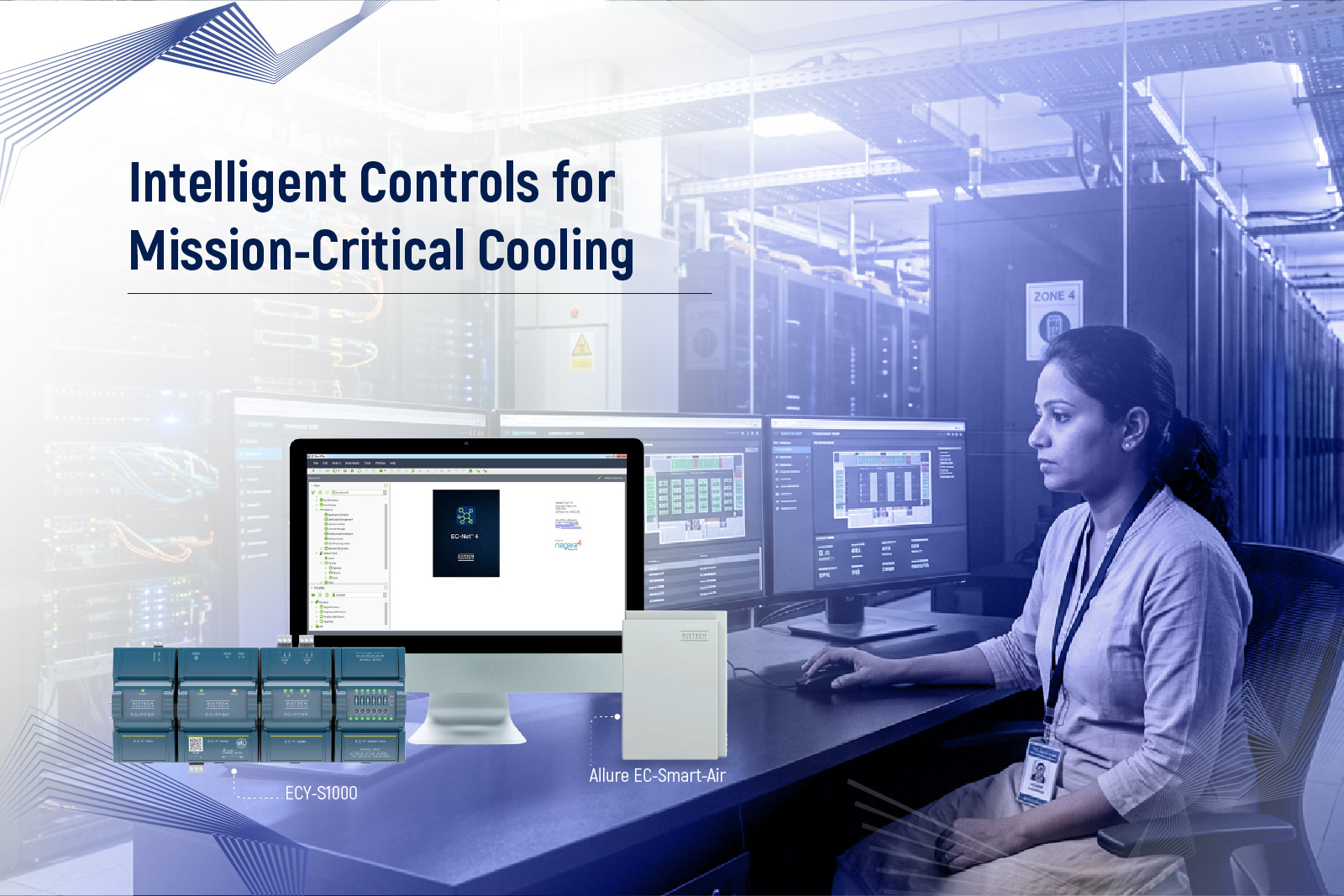
Three core solution areas support the data center application: ECLYPSE® plant controllers, EC-Net supervisory software, and environmental sensors. Together, these technologies address different layers of the building’s automation architecture.
ECLYPSE® Controllers for Plant and HVAC Control
Distech Controls’ ECLYPSE® platform provides programmable controllers for building automation applications. Within data center HVAC, appropriate ECLYPSE controllers can be applied to central plant and mechanical systems depending on the project’s control architecture and I/O requirements.
Applications can include chiller plant control, pump sequencing, cooling-tower coordination, AHU control, mechanical equipment integration, and HVAC plant monitoring.
Control logic can be developed around project-specific sequences, including staging, lead/lag operation, equipment availability, and alarm generation.
For an EPC or consultant, controller selection should therefore consider more than the number of physical I/O points. Processing capability, communication architecture, integration requirements, application complexity, scalability and the project’s overall BMS design should all form part of the selection process.
EC-Net for Centralized Supervision and Visualization
Field controllers execute the HVAC logic, but data center operators also need centralized visibility. EC-Net, based on the Niagara Framework, provides a supervisory environment for integrating, managing and visualizing building automation information.
Within a data center BMS, the supervisory layer can provide centralized access to chiller plant status, pump and cooling-tower operation, CRAH/CRAC status, temperature and humidity, critical alarms, historical trends, schedules, equipment operating parameters and graphical system views.
Instead of accessing several individual equipment interfaces, facility teams can use a centralized BMS environment to understand the wider operating conditions of the cooling infrastructure. This becomes particularly useful during alarm investigation, maintenance, and performance analysis.
Environmental Sensors for Reliable Monitoring
Every control decision begins with field data. Environmental sensors therefore play a fundamental role in precision cooling and server room temperature monitoring.
Temperature and humidity sensors should be selected and positioned according to the actual monitoring objectives of the project. Sensor placement may need to consider equipment arrangement, airflow patterns, cooling strategy, and critical monitoring locations.
The data collected can be used for environmental monitoring, HVAC control, high/low temperature alarms, humidity alarms, historical trending, BMS visualisation, and operational analysis.
For mission-critical applications, sensor accuracy, placement and calibration should be treated as part of the controls engineering process—not simply as installation details
From Chiller Plant to Data Hall: Typical BMS Applications
A data center building management system can support automation and monitoring across multiple parts of the mechanical infrastructure. Typical applications include chillers and chiller plants, pumps, cooling towers, CRAH units, CRAC units, AHUs, precision cooling systems, server-room environmental monitoring, temperature and humidity monitoring, energy monitoring and other integrated HVAC systems.
The exact BMS scope will depend on the facility design. For this reason, data center controls should not begin with a standard list of controllers or BMS points. They should begin with an understanding of the mechanical architecture, redundancy philosophy, sequence of operation, integration requirements, and monitoring expectations.
How Messung BACD Supports Data Center EPCs
Technology is only one part of a successful data center automation project. The other part is engineering.
Messung Building Automation & Control Division (BACD) works with EPC contractors, consultants and project teams to translate mechanical and operational requirements into a practical building automation solution. Support can begin during the engineering and BOQ stage and continue through system integration and commissioning.
- BMS Architecture & Controller Selection – Selection of appropriate control architecture and controllers based on the project’s mechanical systems, I/O requirements, communication requirements and application complexity.
- Chiller Plant Automation – Development and implementation of control strategies for chillers, pumps, cooling towers and associated central plant equipment.
- CRAH/CRAC Application Engineering – Engineering support for precision cooling and data-center HVAC applications.
- Redundant HVAC Control -Development of control strategies around lead/lag, duty/standby and equipment availability requirements.
- BOQ & Technical Specification Support – Support in defining controller, supervisory software, sensor and integration requirements.
- BACnet Integration – Integration of compatible third-party equipment within an open building automation architecture.
- Graphics, Alarms & Trends – Development of centralized visualization and monitoring aligned with the operational needs of the facility.
- Testing & Commissioning – Verification of controls, sequences, alarms and system operation during project commissioning.
- Lifecycle Technical Support – Continued technical support for building automation requirements after system deployment.
This engineering-led approach is particularly important for data centers because the controls solution must reflect the actual operating philosophy of the facility.
Why Partner with Messung BACD for Data Center Automation?
Mission-critical building automation requires more than supplying controllers, sensors, and software. It requires an understanding of how the complete HVAC system is expected to operate.
Messung BACD combines application engineering with open building automation technology to support data center HVAC and BMS requirements.
As an Authorized Distributor of Distech Controls in India, Messung BACD provides Distech Controls building automation solutions backed by local engineering, integration, commissioning and technical support.
- Open BACnet Architecture – Supporting interoperability with compatible third-party building systems and reducing unnecessary proprietary dependency.
- Advanced Building Controls – ECLYPSE® controller technology for HVAC and central-plant applications.
- Centralized Supervision – EC-Net supervisory capabilities for graphics, alarms, trends and integrated system visibility.
- Application Engineering – Support for chiller plants, CRAH/CRAC systems, redundant HVAC and other complex mechanical applications.
- Project Lifecycle Support – Engineering assistance from controller selection and BOQ development through commissioning and ongoing technical support.
- PAN-India Support – Technical and project support for building automation applications across India.
The objective is not simply to automate individual pieces of HVAC equipment. It is to create a coordinated, open, and scalable building automation architecture that gives data center operators the control and visibility required for mission-critical cooling infrastructure.
Data Center Uptime Begins at the Controls Layer
Data center reliability is built through multiple layers of infrastructure. Power systems must remain available. IT equipment must operate within the required conditions. Cooling infrastructure must continuously remove heat. Environmental conditions must remain within the defined operating limits.
Behind the cooling infrastructure, the BMS plays an important role in coordinating. It tells equipment when to operate. It monitors whether systems are responding correctly. It coordinates redundant equipment. It records operating conditions. And it alerts facility teams when something requires attention.
For this reason, data center BMS architecture should be engineered early, alongside the mechanical design, cooling strategy and redundancy philosophy, not added as a final monitoring package.
For EPCs, consultants and data center developers planning a new facility, expansion, retrofit or cooling-system upgrade, Messung BACD can support BMS architecture, controller selection, chiller plant automation, CRAH/CRAC applications, BACnet integration, environmental monitoring and centralized supervision.
Talk to Messung BACD about your next data center building automation project.
Frequently Asked Questions
What makes building automation for data centers different from commercial buildings?
Commercial building automation typically focuses on occupant comfort, operating schedules, and energy management. Data centres require continuous cooling, environmental monitoring, HVAC redundancy, alarm management, and high system availability. The BMS architecture and control sequences therefore need to reflect the mission-critical requirements of the facility.
Can Messung BACD support Tier III and Tier IV data center projects?
Messung BACD can support BMS and HVAC-control requirements for data center projects designed around high-availability and redundant infrastructure concepts, including projects where Tier III or Tier IV requirements form part of the overall facility design. The final Tier classification applies to the complete data center infrastructure and should not be attributed to the BMS alone.
Why is BACnet important for data center automation?
BACnet is an open communication protocol developed for building automation and control systems. It allows compatible controllers, HVAC equipment, and other building systems from different manufacturers to exchange information. For data centers, this can improve interoperability, integration flexibility, scalability, and long-term maintainability.
How does a Building Management System improve data center energy efficiency?
A BMS can support efficient HVAC operation through strategies such as chiller sequencing, pump control, cooling-tower coordination, optimized equipment staging, and continuous performance monitoring. Historical trend data can also help facility teams identify inefficient operating conditions while maintaining the required environmental and reliability limits.
What support does Messung BACD provide during a data center project?
Messung BACD can support EPCs, consultants and project teams with BMS architecture, controller selection, chiller plant and HVAC application engineering, CRAH/CRAC applications, BOQ and technical specification support, BACnet integration, environmental monitoring, graphics, alarms, trends, testing, commissioning and lifecycle technical support.