Introduction
In modern infrastructure, whether it’s a data centre, pharmaceutical facility, or large commercial building, cooling is not just a support system; it is a mission-critical function that directly impacts operational continuity.
A failure in the cooling system can lead to:
- Occupant discomfort
- Process disruption
- Production loss
- Regulatory risks
- Huge cost impact
In environments like data centres or pharma plants, even a few minutes of cooling failure can result in significant financial losses or compliance violations.
Yet, traditional chiller plants often operate as isolated systems with limited coordination between equipment. Chillers, pumps, and cooling towers function independently, leading to:
- Inefficient energy utilization
- Poor load distribution
- Delayed response to system changes
- Increased risk of system failure
This is where a Chiller Plant Management System (CPM) plays a transformative role.
By integrating intelligent control, real-time monitoring, and redundancy architecture, CPM solutions built using Distech Controls products and delivered by Messung Systems Pvt Ltd enable facilities to achieve high reliability, optimised energy usage, and continuous operation.
What is a Chiller Plant Management System?
A Chiller Plant Management System is a centralised automation solution that manages the complete cooling ecosystem of a facility.
Instead of operating individual components independently, CPM brings together:
- Chillers
- Primary and secondary pumps
- Condenser systems
- Cooling towers
Including associated equipment in the plant room into a single coordinated and intelligent system.
This coordination ensures that all equipment works in synchronisation rather than isolation, allowing the system to respond dynamically to changing load conditions.
The objective is simple yet critical:
- Deliver the required cooling with maximum efficiency and minimum energy consumption, while ensuring uninterrupted operation.
Understanding the System Architecture
A well-designed Chiller Plant Management System follows a layered architecture, ensuring scalability, reliability, and real-time responsiveness.
Supervisory Layer – Central Intelligence
At the top level, the system uses dual supervisory platforms based on the Niagara Framework.
These act as the brain of the system and are responsible for:
- Monitoring the entire plant
- Managing alarms and events
- Visualising system performance
- Executing high-level control strategies
In advanced setups, two supervisory systems operate in a primary–secondary configuration, continuously synchronising data between them.
This means:
- Both systems always have the latest operational data
- The standby system is always ready to take over
- No loss of system state during transition
This layer ensures centralised visibility and decision-making across the entire plant.
Network Layer – Reliable Communication Backbone
Communication between system components is maintained through a redundant Ethernet network, which acts as the backbone of the entire system.
This includes:
- Dual network switches
- Parallel communication paths
- Redundant BUS architecture
Such a design ensures that even if one communication path fails, the system automatically switches to the alternate path without affecting operations.
This results in:
- Continuous data flow
- High communication reliability
- Reduced risk of system-wide failure
Controller Layer – Distributed Intelligence
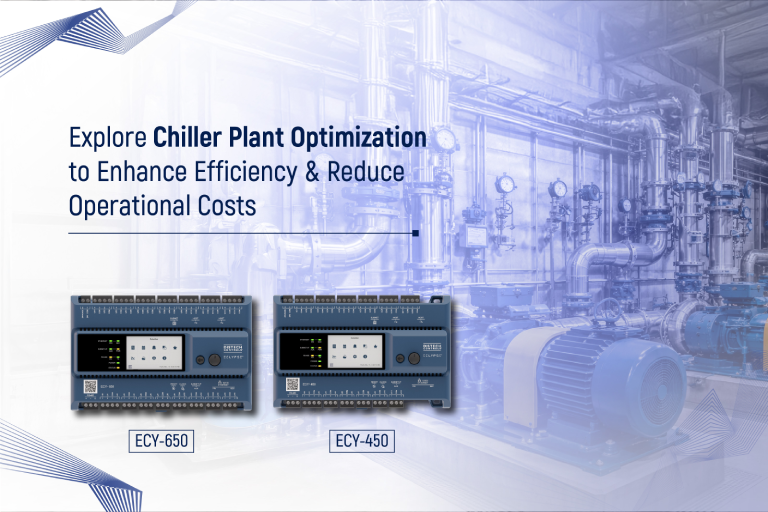
At the core of the system are DDC (Direct Digital Controllers) such as ECY series controllers, ECY S100, ECY APEX, ECY 450/650, deployed across different plant sections.
These controllers:
- Execute real-time control logic
- Manage equipment operations
- Ensure localized decision-making
Each controller is responsible for a specific section of the plant (e.g., a chiller or pump set), allowing a distributed control architecture.
Even in the event of supervisory failure, these controllers continue to operate independently, maintaining system stability and preventing shutdown.
➡ This ensures that the plant remains operational even during higher-level failures.
Field Layer – Equipment Integration
The field layer includes all physical equipment connected to the system, such as:
- Chillers
- Pumps
- Cooling towers
Each component is continuously monitored and controlled based on:
- Temperature
- Flow
- Pressure
- Load demand
Sensors provide real-time feedback, and controllers adjust operations accordingly, ensuring optimal performance.
Redundancy: The Foundation of Reliability & Resiliency
One of the most critical aspects of modern CPM systems is redundancy architecture, especially in critical infrastructure.
In such environments, downtime is unacceptable. To address this, the system incorporates:
- Active-standby supervisory systems
- Real-time data synchronisation
- Automatic failover mechanisms
When a failure occurs:
- The system detects the fault instantly
- The standby system takes over control
- Data continuity is maintained
- Operations continue without interruption
This ensures:
Zero single point of failure
Continuous system availability
Intelligent Control & Optimisation
Beyond monitoring and control, CPM systems are designed to optimise performance continuously based on real-time data.
Load-Based Chiller Sequencing
Instead of running all chillers simultaneously, the system:
- Activates chillers based on demand
- Optimises load distribution across units
- Prevents unnecessary energy consumption
This improves overall system efficiency significantly.
Pump & Cooling Tower Optimisation
Using variable speed drives and control logic:
- Pumps operate based on actual flow requirements
- Cooling towers adjust dynamically based on heat load
This ensures energy is used only when required.
Real-Time Performance Monitoring
Continuous monitoring allows operators to:
- Identify inefficiencies early
- Detect faults before they escalate
- Take proactive corrective action
Applications
Chiller Plant Management Systems are widely used in:
- Data Centers
- Pharmaceutical Facilities
- Industrial Manufacturing Plants
- Commercial Buildings (IT Parks / Offices)
- Hospitals & Healthcare Facilities
These environments require continuous cooling, precise control, and high operational reliability.
Key Benefits
Implementing a CPM system delivers:
- Improved energy efficiency
- Reduced operational costs
- Enhanced system reliability
- Faster fault detection
- Extended equipment life
Conclusion
A Chiller Plant Management System is no longer just an upgrade, it is a necessity for modern infrastructure.
By combining intelligent automation, redundancy, and system integration, organisations can ensure that their cooling systems operate efficiently, reliably, and without interruption, even under critical conditions.